
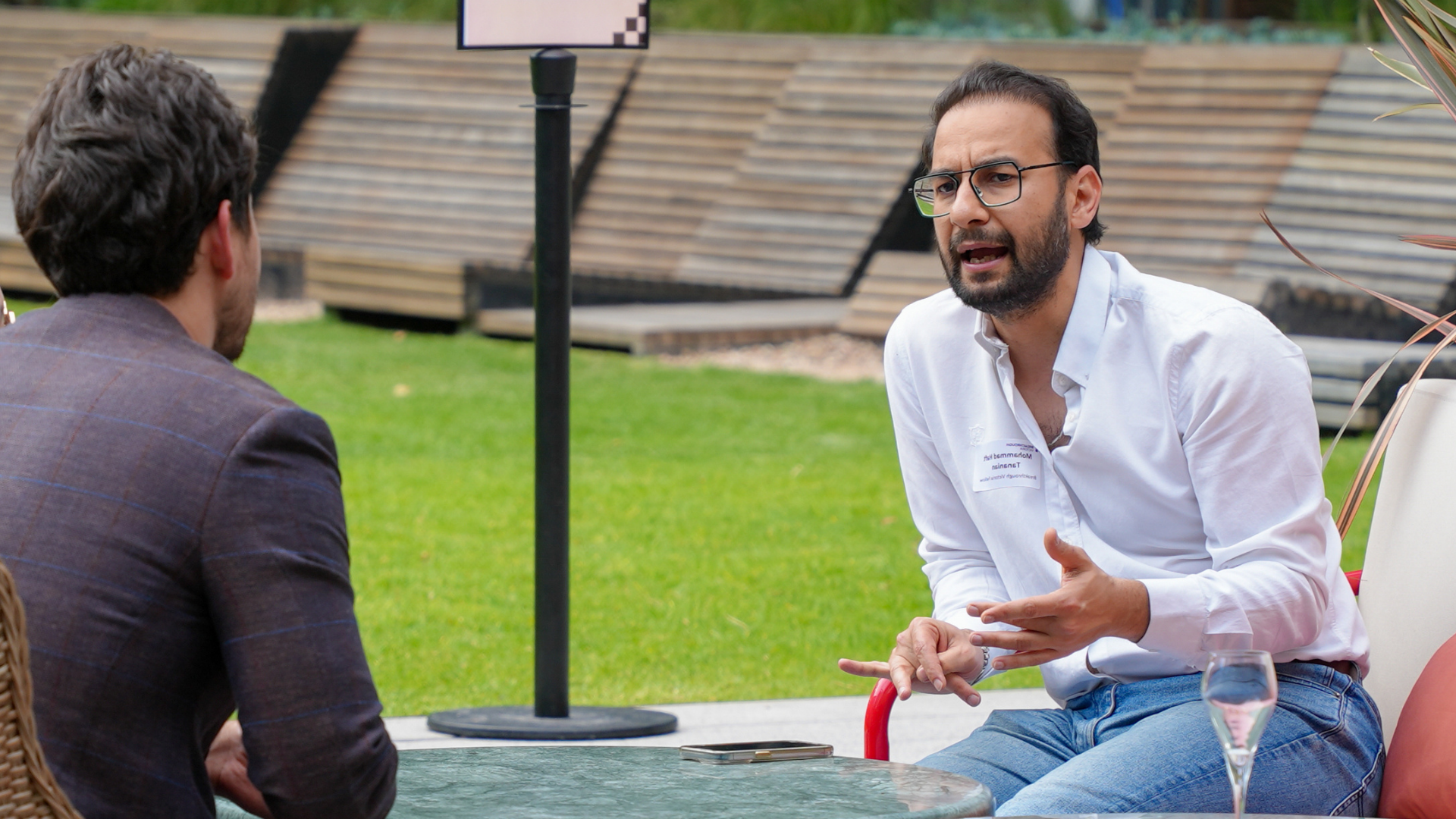
Breakthrough Victoria Fellow, Mohammad Haft Tananian (Monash University researcher), developed a new technology that sits at the crossroads of physics, optics and biology. This revolutionary technology has many potential applications in healthcare and related life-science settings. What Dr Tananian discovered during his first 6 months of the Fellowship is that choosing the right first application and beachhead market matters as much as the science, because it dictates the pathway to adoption, partners and time to revenue.
1. Looking back to when you applied, what convinced you that the BV Fellowship was the right step for your idea or research?
The Fellowship made the difference between having an idea and launching a startup. Without Breakthrough Victoria (BV), we simply wouldn’t have been able to form a company or even seriously consider doing so. We had just produced the first results from our technology, but we hadn’t had the time to build investor appeal, generate traction, explore different markets, or gather feedback on where the strongest commercial opportunity might be.
If I’d taken a postdoc position instead, I would have stayed in the lab - with limited exposure to investors, potential partners, or customers. The BV Fellowship created the conditions for us to learn, explore and build. A postdoc would have deepened the science. The Fellowship forced me to confront the market.
BV also expanded our network dramatically. The inspiration for our pivot came directly from a BV-enabled introduction from Olga Hogan, that led to an angel investor. When I pitched the IVF market, he challenged me to think about whether that small, highly regulated market matched the scale of the platform we were building. His push to consider a bigger vision opened new pathways, new markets, and ultimately shaped the direction of the company. That shift would not have happened without BV.
The Fellowship didn’t just provide funding; it gave us the time, space and structure to incorporate the company, test the commercial landscape, and position ourselves for our first capital raise.
2. How has your project or startup evolved over the past 6-12 months, and what role did the Fellowship play in that progress?
We’ve conducted well over 200 conversations since the Fellowship began. Initially, we focused on embryo scanning. Then we explored adding a portable spermanalysis device to broaden the market and increase investor appeal. That alone involved 50-60 conversations for embryos and another 30-40 for sperm analysis. Now that we’re moving into microendoscopy, we’re speaking with surgeons, strategic partners, and others across the clinical ecosystem.
This journey has helped us validate assumptions, eliminate weak paths, and strengthen the vision for our platform. And the Fellowship has been central to that progress.
BV provided structure, guidance and discipline. In a startup, you can chase a hundred ideas at once, especially early on when everything feels possible. BV helped us prioritise: what matters this year, what can wait, and what will genuinely move us forward. They helped us stay focused, not scattered. That discipline shifted us from exploring interesting applications to deliberately building toward scalable, defensible market opportunities.
3. What has been the biggest shift for you personally in moving from researcher or innovator to founder?
The biggest shift has been learning to talk to people. I wasn’t someone who enjoyed conversations or networking. Now it’s a daily part of my life - speaking with investors, clinicians, customers, partners and potential hires.
Another major change is learning to choose the right people to work with. In academia, a collaboration can last for a paper. In a startup, it can define the next decade of your life. You have to read red flags, assess values and decide whether these are the people you want alongside you in a high pressure, long term journey.
I’ve also learned that customers don’t care about your technology - they care about whether it solves their problem. I used to think great technology was enough. But when you speak with potential customers, their questions are practical:
How will I use it? Does it fit into my workflow? What does it cost? Is it disposable? How do I hold it?
That shift from proving scientific novelty to proving workflow fit, fundamentally changed how I build products. It’s a completely different mindset from research, and it has reshaped how I work.
4. Can you describe a breakthrough moment over the past six months when you realised your work had real commercial potential?
A pivotal moment came from a conversation with an angel investor - again through a BV connection. I was pitching the IVF market, and he immediately pointed out the mismatch: we were building a platform with huge potential, but narrowing it to a tiny, highly regulated niche simply because it was familiar from my PhD work. That was the moment I realised I was still thinking like a researcher, not like a founder.
That challenge opened my eyes to the bigger picture. As I explored other markets and spoke to more people, I realised the platform had far broader potential than I imagined. For example, while IVF imaging represents a relatively small and highly specialised segment, global endoscopy markets exceed tens of billions of dollars annually. The platform’s optical capabilities were better aligned with that scale. That shift in perspective - seeing beyond my original academic comfort zone - was the breakthrough.
5. If you had to distil one lesson from your first six months of building a company, what would it be?
It’s not about the technology -it’s about traction. Traction creates leverage. Technology alone does not.